
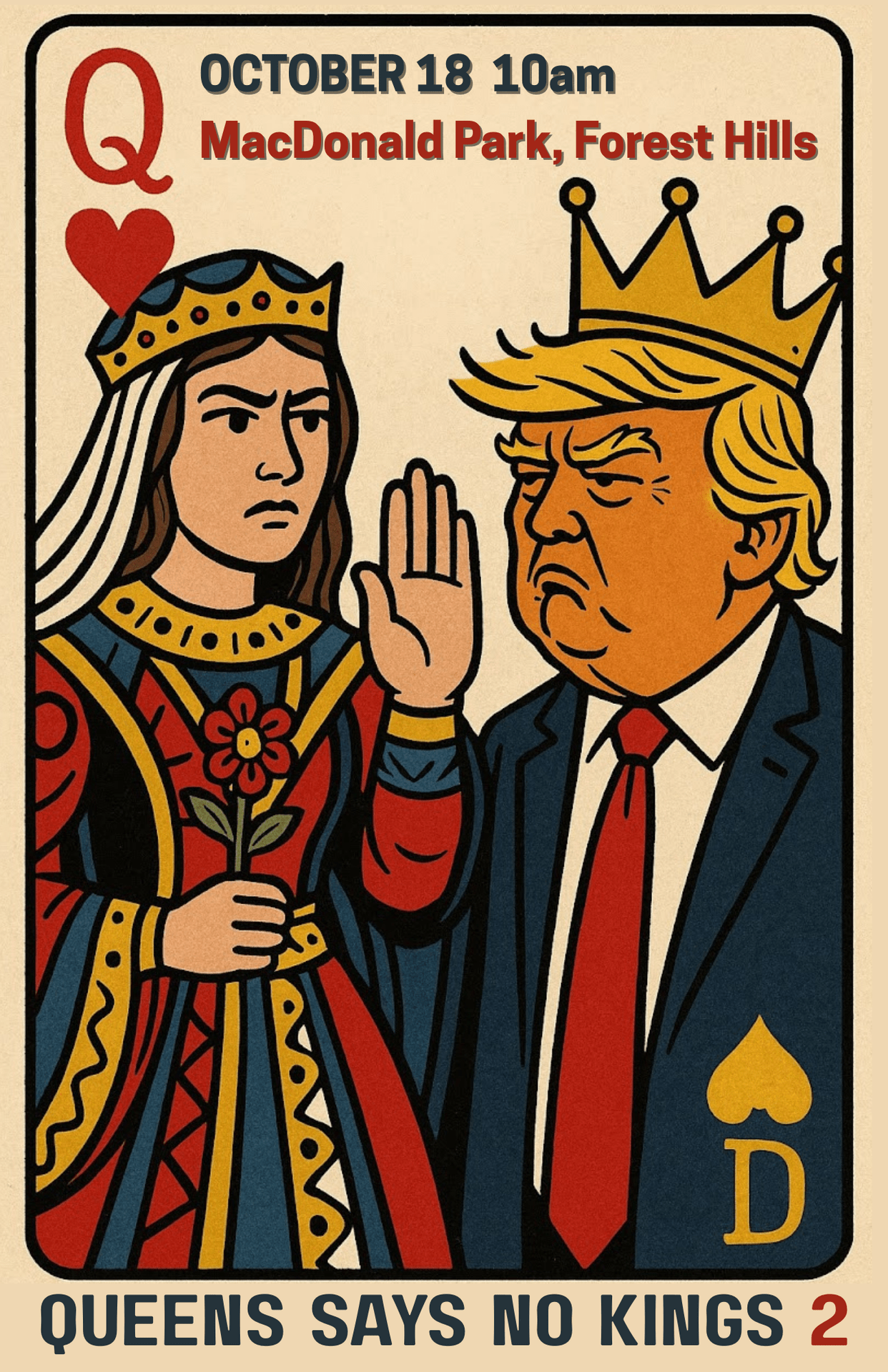
Queens Says No Kings is a Queens-based activist coalition formed in late 2024 in direct response to the reelection of Donald Trump. From the beginning, it brought together leaders of existing Queens activist groups who understood that the political moment demanded coordination across neighborhoods and organizations, not isolated actions. What followed was not a smooth or linear process, but a sequence of actions, leadership transitions, and creative breakthroughs that reshaped how large-scale resistance organizing took form in Queens.
Formation: Stop the Steal for Real (Late 2024)
The coalition began in late 2024 under its original working name, Stop the Steal for Real. The name reflected a clear rejection of authoritarian narratives and a commitment to democratic legitimacy in the aftermath of Trump’s reelection.
From the outset, the project was conceived as a coalition, not a new standalone organization. Its purpose was to bring together leaders of existing Queens-based activist groups so they could act collectively while maintaining their individual missions and political identities.
At formation, the coalition was led by Ida Messina, founder of Let’s Talk Democracy. Under her leadership, early coordination began among groups that had often worked in parallel but rarely in sustained collaboration.
June 14, 2025: The First No Kings March in Queens
The coalition’s first real test came quickly. On June 14, 2025, Queens Says No Kings—still operating under its original name—helped pull off the first No Kings March in Queens, working alongside Jackson Heights Indivisible. Organized under intense time pressure and with limited infrastructure, the march was pulled together by the skin of its teeth but succeeded in establishing the coalition as a credible organizing force.
Speakers included Grace Meng and Andrew Hevesi, and the action demonstrated that borough-wide coordination in Queens was not only possible, but effective. The march made visible something that had previously existed only in conversation: a shared capacity to act together at scale.
The Queens Activism Summit and Naming the Coalition (Summer–Fall 2025)
In August 2025, the coalition organized the Queens Activism Summit at Astoria Manor, bringing together 22 Queens-based activist groups. The summit focused on organizing infrastructure rather than optics—how groups communicate, coordinate, and sustain momentum—and marked a turning point in coalition-building by creating a shared space for strategic alignment across neighborhoods and issue areas.
In the months that followed, building on the momentum of both the June march and the summit, organizers made a deliberate decision to formally adopt the name Queens Says No Kings, aligning the coalition’s identity with the action that had brought it into public view. The name change signaled a shift from emergency coordination toward something more durable: an ongoing, borough-wide political project.
During this same post-summit period, coalition leadership transitioned from Ida Messina to Diana Paley, positioning Diana Paley to lead the coalition into its next major action.
No Kings 2: Forest Hills and a Turning Point (October 18, 2025)
On October 18, 2025, Queens Says No Kings organized No Kings 2 in Forest Hills—an action that represented the coalition’s most significant leap forward to date. Where the first march had proven that a borough-wide coalition could function, No Kings 2 demonstrated what it could become.
The march reflected a clear evolution in scale, confidence, and intentionality. Organizing was no longer purely reactive. Coordinated art builds gave the action visual coherence and presence well before the march began, drawing people into the process as participants rather than spectators. A stronger, unified visual identity made the action legible from a distance and recognizable across photos and neighborhoods, signaling that this was not an isolated event but part of an emerging movement culture.
Live music played a central role in reshaping the atmosphere of the march, including performances by the Resistance Revival Chorus. Their presence transformed the action from a sequence of speeches into a shared civic space—one that people lingered in, moved through, and experienced collectively. Music created emotional continuity, grounding the protest in solidarity rather than urgency alone.
Speakers included Antonio Delgado, the Lieutenant Governor of New York, whose participation underscored the coalition’s growing visibility and credibility while reinforcing that No Kings 2 remained rooted in grassroots organizing.
Most importantly, No Kings 2 marked a fundamental shift in how protest functioned within the coalition. It was less transactional and more communal. People did not simply arrive, listen, and leave. They stayed. They took photos. They recognized symbols. They saw themselves reflected in the art, the music, and one another. The march functioned as a gathering place—a moment where participants experienced themselves as part of something ongoing rather than episodic.
Queens Resistance Art Comes Into Focus
Resistance art in Queens did not begin with No Kings 2. It had long existed—in handmade signs, neighborhood banners, improvised graphics, and visual languages shaped by earlier movements. What changed in the fall of 2025 was not the presence of resistance art, but the attention it received and the coherence it was finally afforded.
At No Kings 2, a recognizable visual language came into focus. The Resist Flower emerged as the most widely recognized image, but it appeared alongside other pop-art-inflected motifs: bold typography, simplified graphic forms, high-contrast color palettes, and repeatable symbols designed to read clearly at a distance and reproduce easily across banners, signs, and prints.
Resistance Art Finds a Wider Audience: Yant Art Space (Fall 2025)
In the aftermath of No Kings 2, coalition member Alyce Wittenstein curated a resistance art show at Yant Art Space. The exhibition brought increased visibility to work that had already been circulating in public space, offering a gallery context that amplified — rather than redefined — its political force.
The show established that Queens resistance art was not decorative or incidental, but structurally important. It connected street-level organizing with cultural visibility, reinforcing art as movement infrastructure — a way movements build memory, continuity, and recognition over time.
December 2025 and What Comes Next
In December 2025, Diana Paley stepped down, and Alyce Wittenstein assumed leadership of Queens Says No Kings, a transition that reflected continuity rather than rupture and underscored a coalition built around shared purpose rather than individual authority. With new leadership in place, work is now underway on the next Queens Says No Kings march, including plans for a large-scale art build in collaboration with Jackson Heights Indivisible. Art builds remain central to the coalition’s approach—not as aesthetics, but as organizing infrastructure that invites participation before an action and leaves durable images behind long after it ends.
Why Queens Says No Kings Endures
Queens Says No Kings exists because collaboration is necessary in a borough as large, complex, and politically diverse as Queens. From its formation in 2024 through mass marches, a borough-wide summit, the consolidation of a visible resistance art culture, and multiple leadership transitions, the coalition’s history shows how collective organizing can hold together over time.
Queens says no kings—publicly, repeatedly, and together.