
Queens Says No Kings: The Making of a Queens-Wide Resistance Coalition
Alyce WittensteinQueens Says No Kings is a Queens-based activist coalition formed in late 2024 in direct response to the reelection of Donald Trump. From […]
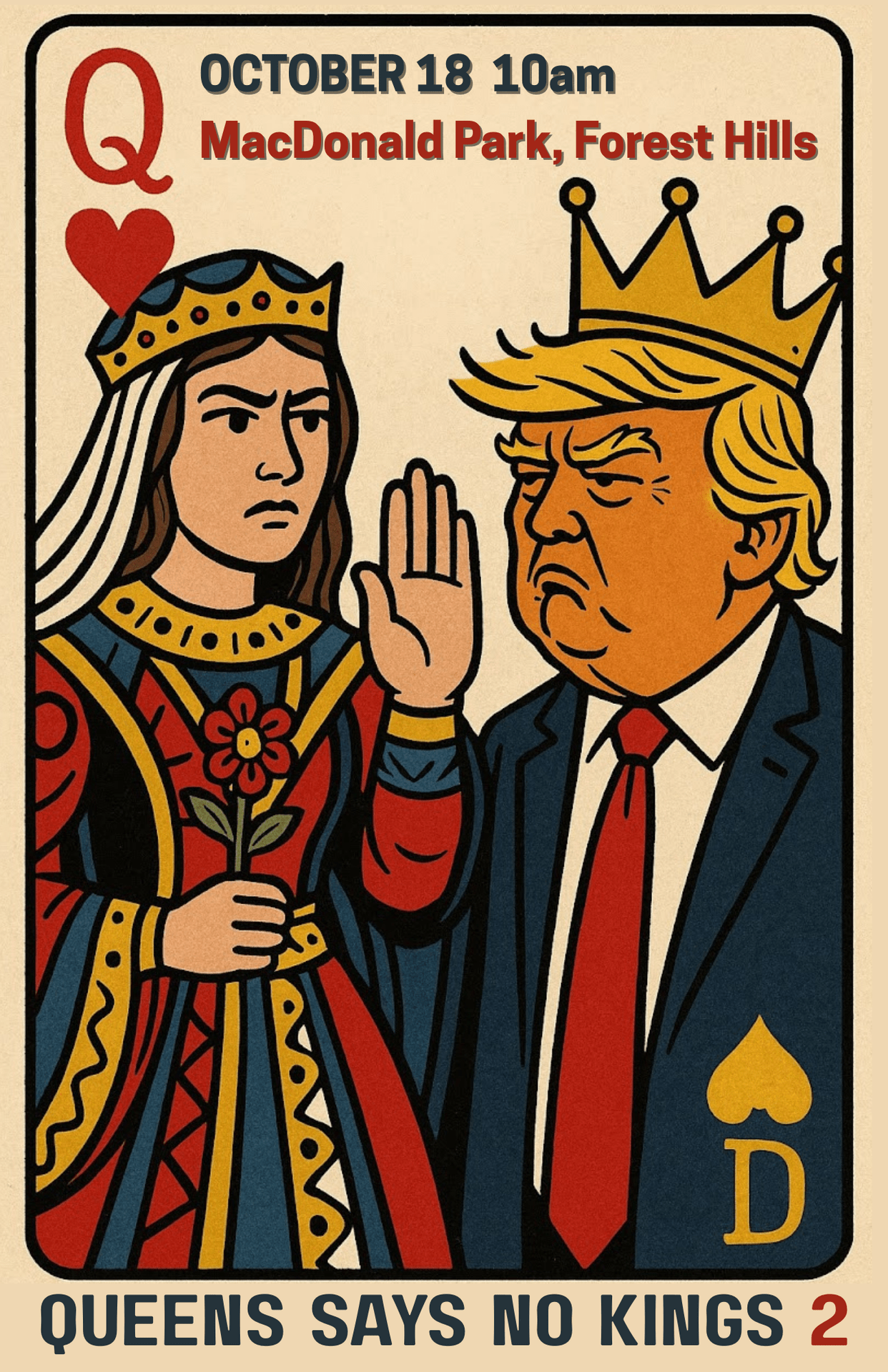
Queens Says No Kings is a Queens-based activist coalition formed in late 2024 in direct response to the reelection of Donald Trump. From […]

Community doesn’t appear fully formed. It’s built through repetition, trust, and showing up when it would be easier not to.
In Queens, […]

An art build is a gathering that happens before a protest, march, or rally to create large-scale, coordinated visual elements that will be deployed together in public space. Rather than focusing on a single object, an art build brings people together to construct a shared visual language—one that can hold across streets, crowds, architecture, and cameras. Some kinds of political expression can’t be made by one person, at one table, in one afternoon; they require planning, shared labor, and agreement about how a movement wants to appear when it shows up.
Art builds are a core practice in contemporary protest movements, especially in New York City, where demonstrations unfold across large, complex urban spaces and are documented instantly through photography, video, and social media—a pattern that also appears clearly in Washington, DC, Boston, Los Angeles, and Portland.
When a movement incorporates art builds, it strengthens how clearly the action registers in public space. Repeated colors, forms, and scale make the message readable across distance, crowds, and media coverage. Instead of each element competing for attention, the visuals work together so the action is understood at a glance and remembered afterward. Over time, these repeated choices become recognizable. The message doesn’t need to be reintroduced each time—it accumulates.
In New York City, wide avenues and dense crowds reward clarity. In Manhattan No Kings actions, large yellow banners span curb to curb, while vertical signage and crossed-out crown symbols repeat above the crowd. The same colors and forms appear again and again. The message doesn’t evolve from sign to sign; it builds density through consistency.
In New York City actions organized in Queens, that consistency is paired with place-specific imagery. Large front banners name the borough directly, while recurring illustrated elements—most notably the Resist Flower—appear at scale and are elevated above the crowd, serving as visual anchors. These images carry identity as much as text. The action can be recognized without reading anything at all.
In Washington, DC, art builds often take a performative form. Wearable sculpture, matching uniforms, and chained figures move together through institutional space. Meaning is carried through costume, movement, and choreography rather than banners. The group reads as a single constructed scene in motion.
In Boston, protest imagery draws on regional symbols. Oversized lobster costumes—immediately legible as New England—carry the message through form first, text second. Place and politics arrive together, without explanation.
In Los Angeles and along California’s coastline, art builds expand to landscape scale. On beaches, hundreds of people arrange themselves to spell messages large enough to be read from the air. Bodies become material. The message fully exists only from a distant vantage point, designed for aerial photography and wide circulation.
In Portland, long-running actions have produced distinctive, repeatable imagery that travels beyond the city itself. Symbols like the inflatable frog appear across multiple actions and formats, becoming familiar through repetition. The image carries meaning through use and reuse, signaling shared participation rather than centralized authorship.
Poster-making workshops matter. They invite participation, help people find their voice, and are often how individuals first enter a movement.
Art builds serve a different function. They are used when a movement wants to remain legible across distance, hold together visually in large crowds, read clearly in photographs and video, and stay recognizable from one action to the next. The work is large, heavy, repetitive, and time-consuming. It takes many hands because the objects—and the images—cannot exist otherwise.
Art builds are where movements take shape before they take the street. They are the moment when ideas stop being theoretical and become physical: banners that have to be lifted, images that have to be carried, forms that only work if people move together. Through that shared labor, a movement makes decisions about scale, color, placement, and presence—decisions that determine how it will register once it enters public space.
What comes out of an art build is not just artwork. It is coordination and shared authorship, a collective commitment to showing up in a particular way. That commitment is what allows an action to read clearly across distance, across cities, and across time, even as the people involved change. Art builds keep reappearing because they solve a recurring, practical problem: how to make collective action visible, coherent, and intentional in environments that are crowded, noisy, and constantly mediated.
An art build is where that visibility is made—before anyone ever steps into the street.

Art movements are shaped by geography — not just aesthetics.
For decades, Brooklyn functioned as New York’s shorthand for experimental political art. That reputation was earned. Poster workshops, print collectives, underground presses, and radical galleries played a real role in anti-war organizing, labor movements, and later global justice actions.
But movements migrate.
Queens is where political art now intersects most directly with lived conditions. It is where organizers, immigrants, students, workers, and artists share space without insulation. The art is less polished, less ironic, and more accountable to consequence.
That shift mirrors global patterns. In cities worldwide, the most effective protest art emerges not from cultural centers, but from pressure points — places where policy is felt immediately, not abstractly.
Queens fits that profile.
Art builds here are not spectacles. They are preparatory acts. They happen before marches, before court dates, before elections. They create shared language across communities that may not share ideology but do share stakes.
RESIST FLOWER™ operates inside that ecosystem. It is intentionally simple, reproducible, and mobile. It does not require explanation to function. It does not belong to a single moment or event.
The shop exists because permanence requires resources. Historically, those resources came from institutions aligned with movements. Today, they must be generated differently — without compromising autonomy.
This is not art about resistance.
It is art embedded within it.
👉 The work sustains itself through the shop
https://www.etsy.com/shop/ResistFlower

Political art has never been ornamental. At its best, it has functioned as logistics, memory, and coordination — a parallel system of communication when official systems fail or turn hostile.
From the hand-printed posters of the U.S. Civil Rights era, to anti-apartheid graphics in South Africa, to the silk-screened iconography of May ’68 in Paris, visual language has repeatedly done three things movements require:
signal alignment, create cohesion, and make resistance visible at scale.
In the 1950s and 1960s, civil rights organizers did not treat posters, buttons, and printed materials as accessories. They were how people recognized one another. How messages traveled when mass media refused to carry them. How collective identity took shape across neighborhoods and states. Art was not commentary — it was infrastructure.
That lineage continues globally. The raised fist, the flower, the hand-lettered placard, the repeated symbol — these are not aesthetic coincidences. They are tools refined over decades because they work. They are easily reproduced, emotionally legible, and resistant to distortion.
New York City has always been a central node in that tradition.
Brooklyn has long carried the mythology: lofts, collectives, galleries, political poster shops, the fusion of art and radical politics. But that mythology often obscures the present reality.
Queens is where this work is now being actively built — across languages, generations, and class lines. Queens’ art culture is not extractive. It doesn’t rely on gatekeepers or institutional permission. It emerges from lived political conditions: immigration, labor, housing pressure, surveillance, and organizing that happens alongside everyday life.
That context matters.
RESIST FLOWER™ comes out of this tradition — not as nostalgia, but as adaptation. The flower is a historically loaded form. It has been used to signify mourning and refusal, peace and endurance, fragility and persistence. In protest movements, flowers have often appeared at moments when brute force power meets moral clarity — when violence is exposed rather than mirrored.
This work uses that language deliberately.
But it also recognizes a hard truth contemporary movements face: sustainability is structural, not emotional. Movements fail not because people stop caring, but because material support collapses. Funding dries up. Burnout sets in. Infrastructure disappears between moments of visibility.
That is where the shop comes in — not as “merch,” but as a continuation of movement practice.
Historically, protest art was produced collectively and distributed cheaply or freely, often subsidized by unions, churches, or movement organizations. Those structures are weaker now. The RESIST FLOWER™ shop exists to replace them — transparently and without intermediaries.
The art circulates.
The circulation generates resources.
Those resources fund organizing, art builds, and public action.
This is not new in spirit. It is new in form.
Buying the work is not symbolic support. It is participation in a long-standing model of how political art has always functioned — updated for contemporary conditions.
The flower does not ask for attention.
It assumes continuity.
👉 The RESIST FLOWER™ shop operates as movement infrastructure
https://www.etsy.com/shop/ResistFlower